Build marketing systems, not campaigns
Campaigns create moments; systems create momentum. Here is how to build growth engines that keep improving long after the launch.

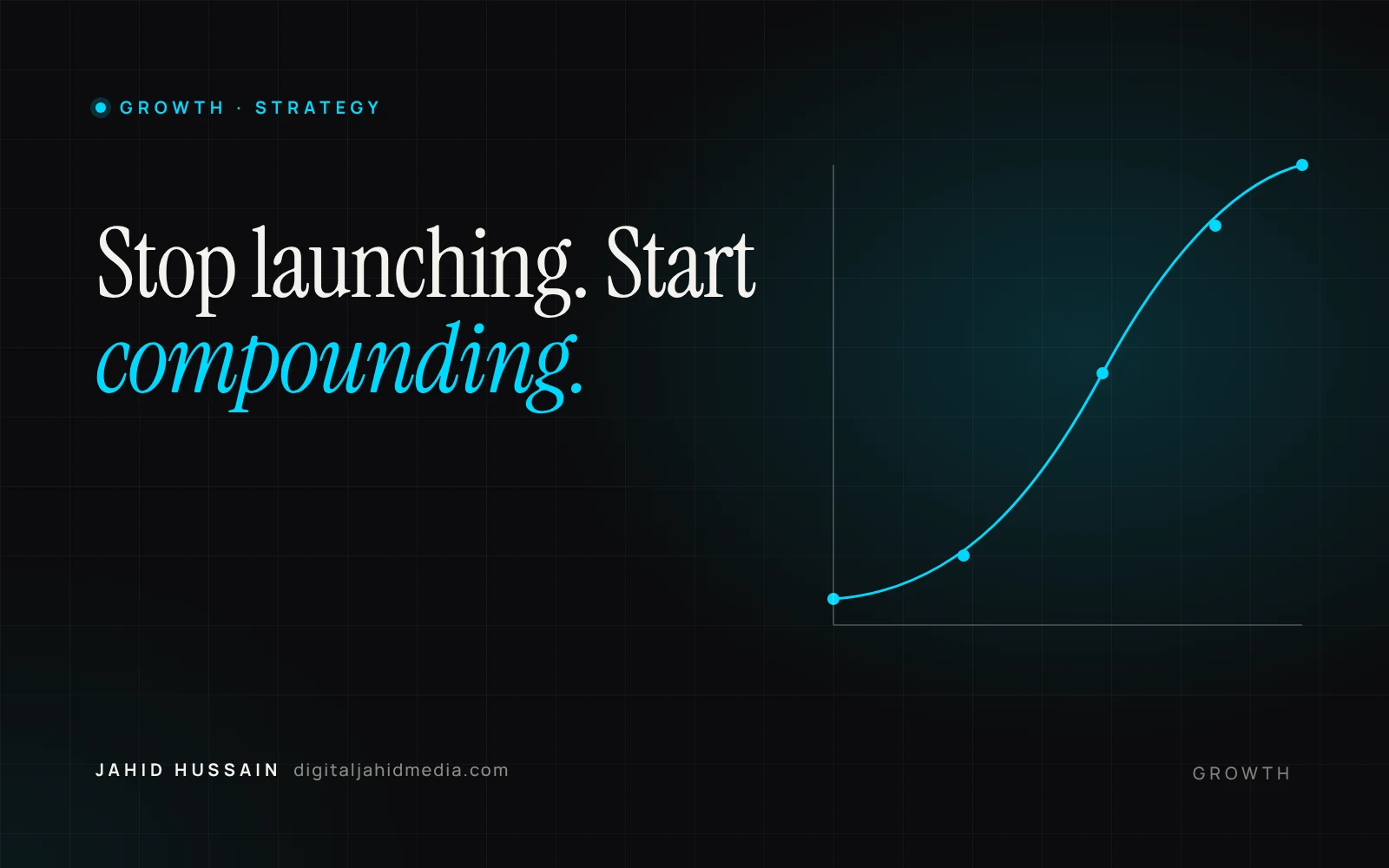
Quick answer
A marketing system is a repeatable growth engine with four parts: defined inputs, a documented process, measurable outputs and a feedback loop that improves the next cycle. Campaigns spike and reset to zero; systems compound. Start with the one channel that already works, document it, template and automate the repeatable steps, then review it on a fixed weekly and monthly cadence.
Most marketing calendars are a list of campaigns. Each one is planned, launched, reported and forgotten, and the next one starts from zero. After seven years in growth marketing, SEO and performance marketing, first inside B2B firms and now running Paradigm Media Networks, I have watched that pattern burn more budget than bad targeting, weak creative and poor landing pages put together.
A system is different. It produces results repeatedly, gets better with each cycle, and doesn't depend on someone remembering to start it. This piece explains what marketing systems look like in practice, the four engines worth building, how to run and measure them, and a step-by-step method for turning your best campaign into something that keeps running after the launch excitement fades.
Key takeaways
- A campaign is an event; a system is an engine with inputs, process, outputs and a feedback loop.
- Four engines do most of the compounding: SEO and content, paid acquisition, lifecycle email, and referral.
- Cadence matters more than tools. A weekly, monthly and quarterly rhythm is what turns activity into improvement.
- Measure systems with leading indicators and cohorts, not only with end-of-campaign reports.
- Build one engine until it runs without you before adding a second.
Why campaigns keep resetting to zero
The campaign model feels productive because it creates visible moments: a launch date, a burst of traffic, a slide in the monthly report. The problem is what happens afterwards. The landing page goes stale, the audience research lives in someone's inbox, the winning ad angle is never reused, and the leads who did not convert in week one receive nothing. Every new quarter begins with the same blank brief.
That waste matters more when budgets are not growing. Gartner's 2025 CMO Spend Survey found marketing budgets flat at 7.7% of company revenue, unchanged from the previous year, with 59% of CMOs saying they lacked enough budget to execute their strategy. If the money is not increasing, the only lever left is getting more from every rupee, dollar or pound you already spend. Systems are how you do that, because each cycle inherits the learning of the last.
Here is my first contrarian view: most businesses do not have a traffic problem or even a conversion problem. They have a memory problem. They keep paying to relearn what they already knew six months ago.
Common mistake
Treating a "successful" campaign as proof the work is done. A campaign that hit its target and was then switched off is often the most expensive kind, because the asset it created (audience data, proven messaging, a converting page) is abandoned at the exact moment it became valuable.
The anatomy of a marketing system
Every marketing system, however sophisticated, has the same four parts. An input is what you feed it: content, budget, data, leads, creative. A process is the documented sequence of steps anyone on the team can run. An output is what it produces: traffic, pipeline, revenue, retained customers. A feedback loop is what you measure and how that measurement changes the next cycle.
The feedback loop is the part almost everyone skips, and it is the only part that creates compounding. Without it you have a routine, not a system. A routine repeats; a system improves.
If a result disappears the week you stop paying attention to it, you built a campaign. If it keeps improving, you built a system.
| Dimension | Campaign thinking | System thinking |
|---|---|---|
| Time horizon | Launch to end date | Ongoing, reviewed in cycles |
| Success measure | Did we hit the target? | Is each cycle better than the last? |
| Knowledge | Lives in people's heads and old decks | Lives in SOPs, templates and a shared log |
| Assets | Built, used once, archived | Built once, reused and refined |
| Dependency | Needs a champion to restart it | Runs on a calendar, not on motivation |
| Failure mode | Silent decay after launch | Visible in the next review, so it gets fixed |
A tactical example: a service business runs a lead-generation push every festive season. As a campaign, the team rebuilds the offer, ads and landing page each year. As a system, the page stays live and indexed, the best-performing ad angles are kept in a creative library, every lead is tagged by source, and non-converters drop into a nurture sequence. Next year's push starts from a working base rather than a blank document.
The four growth engines worth building
You do not need twelve channels. In the audits I run, the businesses with the steadiest growth usually have one or two engines that work extremely well, not a long list of half-maintained ones. These four do most of the compounding.
1. The SEO and content engine
Input: topics drawn from real customer questions. Process: brief, write, publish, interlink, refresh. Output: organic visibility, including in AI answers. Feedback: which pages earn impressions, clicks and enquiries, and which have decayed. Google is explicit that it rewards "content that's created primarily for people", and its own SEO starter guide warns that some changes "could take several months" to show. That delay is exactly why content must be run as a system; nobody sustains a months-long lag on campaign enthusiasm. The engine also needs a sound base, which is why I cover the technical SEO foundations separately, and why I argue GEO is not the new SEO but an extension of it.
2. The paid acquisition loop
Input: budget and a steady supply of new creative. Process: launch, read, kill, scale, replace. Output: qualified leads or sales at a known cost. Feedback: cost per result by angle, audience and offer. On Meta especially, the loop is creative-led, because the algorithm increasingly finds the audience for you; I make that case in creative is the targeting. The system here is a creative pipeline, not a media plan.
3. The lifecycle and email engine
Input: every lead and customer the other engines create. Process: welcome, nurture, convert, onboard, re-engage. Output: conversions from people you already paid to acquire. Feedback: conversion by sequence step and by cohort. This is the engine most small businesses lack entirely, and it is usually the cheapest to build because it reuses traffic you already own.
4. The referral engine
Input: satisfied customers and a clear moment to ask. Process: identify the moment, make the ask, reward, follow up. Output: new customers who arrive pre-trusted. Feedback: referral rate and the quality of referred customers. The evidence for that quality is solid: a study of around 10,000 customers at a German bank, published in the Journal of Marketing, found referred customers were at least 16% more valuable than non-referred ones and had a hazard of defection about 18% lower.
| Engine | Main input | Core feedback metric | Speed to compound |
|---|---|---|---|
| SEO and content | Customer questions, expertise | Impressions, clicks and enquiries per page | Slow start, strongest long-term |
| Paid acquisition | Budget, new creative | Cost per result by creative angle | Fast, but stops when spend stops |
| Lifecycle and email | Existing leads and customers | Conversion by sequence step and cohort | Medium, cheapest to run |
| Referral | Satisfied customers | Referral rate, referred-customer value | Medium, depends on product quality |
What most people miss
The engines feed each other. Content gives paid ads proven angles; paid ads fill the email list; email produces the happy customers who refer. Viewed one at a time, each looks modest. Connected, the outputs of one become the inputs of the next, and that is where the compounding comes from.
The operating cadence that makes systems compound
Tools do not create systems. Rhythm does. A marketing system without a fixed review cadence quietly turns back into a campaign, because nobody looks at the feedback loop until something breaks. The operational reality is that most teams already have the data they need; they simply never schedule the moment to act on it.
I use three rhythms. The weekly review (30 minutes) checks leading indicators: content published, creative launched, leads generated, sequences sent. Its only job is to catch broken inputs early. The monthly review (60–90 minutes) looks at outputs and decides one or two changes per engine: refresh these three pages, kill these ads, rewrite this email. The quarterly review asks whether each engine still deserves its budget and whether a new one is ready to be built.
Pro tip
Keep a single "change log" document per engine. Every time you alter a page, ad, sequence or offer, write the date, the change and the reason. Within two quarters it becomes your most valuable marketing asset, because it tells you what actually moved the numbers.
A second contrarian view: the launch is the least valuable part of any marketing initiative. The value sits in the fourth, eighth and twelfth review, when the process has been tuned against real data. Teams that love launches tend to underinvest in exactly the phase that pays.
How to measure a marketing system
Campaign reporting asks one question at the end: did it work? System measurement asks a better one throughout: is each cycle better than the last? That requires two kinds of metric. Leading indicators tell you whether the inputs are flowing (articles published, creatives tested, referral asks made). Lagging indicators tell you whether the outputs are improving (qualified leads, revenue, retention).
The most useful lens is the cohort. Instead of looking at all leads in a month as one blob, group them by when and how they arrived, then track how each group behaves over time. Google Analytics 4 has this built in: its cohort exploration analyses "a group of users who share a common characteristic" and follows whether they return or transact in later periods. If January's leads convert better than October's after the same number of weeks, your system is improving. If not, the review tells you where to look.
In practice, I give each engine one north-star output metric and two or three leading indicators, no more. A dashboard with forty numbers is a reason to stop looking. Avoid judging a slow engine like SEO on a fast engine's timeline; it is the most common reason good content programmes get cancelled just before they start paying.
How to convert a campaign into a system
You do not need to start from scratch. Your best existing campaign already contains most of a system; it just has not been written down. Pick the one channel that already works best for you, then work through these steps.
- Document what you actually didWrite every step that produced the result, including the unglamorous ones such as who approved copy and where the leads went. If it is not written, it cannot be repeated.
- Separate inputs, process and outputsList what you fed in, what you did and what came out. This exposes which inputs need a steady supply, such as new creative or new topics.
- Template the repeatable stepsTurn briefs, ad structures, email sequences and page layouts into templates so the next cycle starts from version two, not version one.
- Automate or AI-assist the mechanical workLead routing, tagging, first drafts and reporting are good candidates. Keep human judgement on strategy and final quality. My approach is in AI in marketing workflows.
- Define the feedback metricChoose the one number that proves the engine is improving and the leading indicators that predict it.
- Put it on the calendarBook the weekly, monthly and quarterly reviews now. A system without scheduled reviews will revert to a campaign within a quarter.
- Connect it to the next engineDecide where this engine's output goes. Paid leads should feed email; content readers should see a relevant offer; customers should be asked for referrals.
The mistake to avoid here is converting everything at once. Turning five campaigns into five half-built systems produces more admin, not more growth. Build one until it runs without you, then add the next. That build-test-improve loop is the same one I describe in learn, build, test, repeat.
Build your first engine this month
Answer three questions about your strongest channel: which steps could be templated, which could be automated or AI-assisted, and what you would need to measure to know it is improving. Answer those, and you have turned something you do into something that runs. Then protect it with a calendar, a change log and one honest metric.
If you want ready-made templates for parts of the SEO and outreach engines, my products page has them. If you would rather design the whole system with someone who has built these engines across SEO, Meta and Google Ads, content and lifecycle, that is the work I do with clients.
Frequently asked questions
What is a marketing system?
A marketing system is a repeatable process that turns defined inputs, such as content, budget or leads, into measurable outputs like traffic, pipeline and revenue, with a feedback loop that improves each cycle. Unlike a campaign, it does not end on a fixed date or depend on someone restarting it. The feedback loop is the defining feature: it is what makes results compound rather than simply repeat. Most businesses can build their first system from a campaign they already run well.
What is the difference between a marketing campaign and a marketing system?
A campaign is a time-bound event with a launch, a target and an end date, after which its assets and learning are usually abandoned. A system runs continuously on a review cadence, keeps its assets live and feeds what it learns into the next cycle. Campaigns can still exist inside a system, for example a seasonal offer, but they plug into permanent engines such as SEO, email and paid acquisition instead of starting from zero each time.
Which marketing system should a small business build first?
Start with the channel that already produces results, because documenting something that works is far easier than inventing something new. For many small businesses that is either paid ads or referrals. If you already generate leads but convert few of them, build a lifecycle email engine next, since it reuses traffic you have already paid for. Leave SEO as a parallel long-term engine, because it can take months to show impact and needs steady, patient input.
How do you measure whether a marketing system is working?
Give each engine one north-star output metric, such as qualified leads or revenue, plus two or three leading indicators that track inputs, such as articles published or creatives tested. Then compare cohorts: group leads or customers by when and how they arrived and track their behaviour over the same number of weeks. If newer cohorts perform better than older ones, the system is improving. Tools like GA4's cohort exploration make this practical without a data team.
How long does it take to build a marketing system?
Documenting and templating an existing channel can take a few weeks. Proving the system works takes longer, because you need several review cycles to see whether each one improves on the last. Fast engines like paid acquisition show changes within weeks; SEO is slower, and Google itself notes some changes can take several months to be reflected in search. Plan for at least one to two quarters before judging a new engine fairly.
Can AI help run marketing systems?
Yes, mainly in the mechanical parts of the process: first drafts, content briefs, lead tagging, reporting summaries and creative variations. AI works best inside a system because the templates, inputs and quality standards are already defined, so its output can be checked against something. It is weaker at strategy, positioning and deciding what to stop doing. Keep humans in charge of the feedback loop and final judgement, and use AI to increase the volume and speed of inputs.
Sources
- Gartner 2025 CMO Spend Survey Reveals Marketing Budgets Have Flatlined at 7.7% of Overall Company Revenue — Gartner, 2025
- Creating helpful, reliable, people-first content — Google Search Central, 2025
- Search Engine Optimization (SEO) Starter Guide — Google Search Central, 2025
- Referral Programs and Customer Value (Schmitt, Skiera and Van den Bulte) — Journal of Marketing, 2011
- [GA4] Cohort exploration — Google Analytics Help, 2025

Digital Marketing Consultant & Growth Strategist and founder of Paradigm Media Networks. 7+ years in SEO, AI search, paid media and growth. Work with me · Free & premium resources